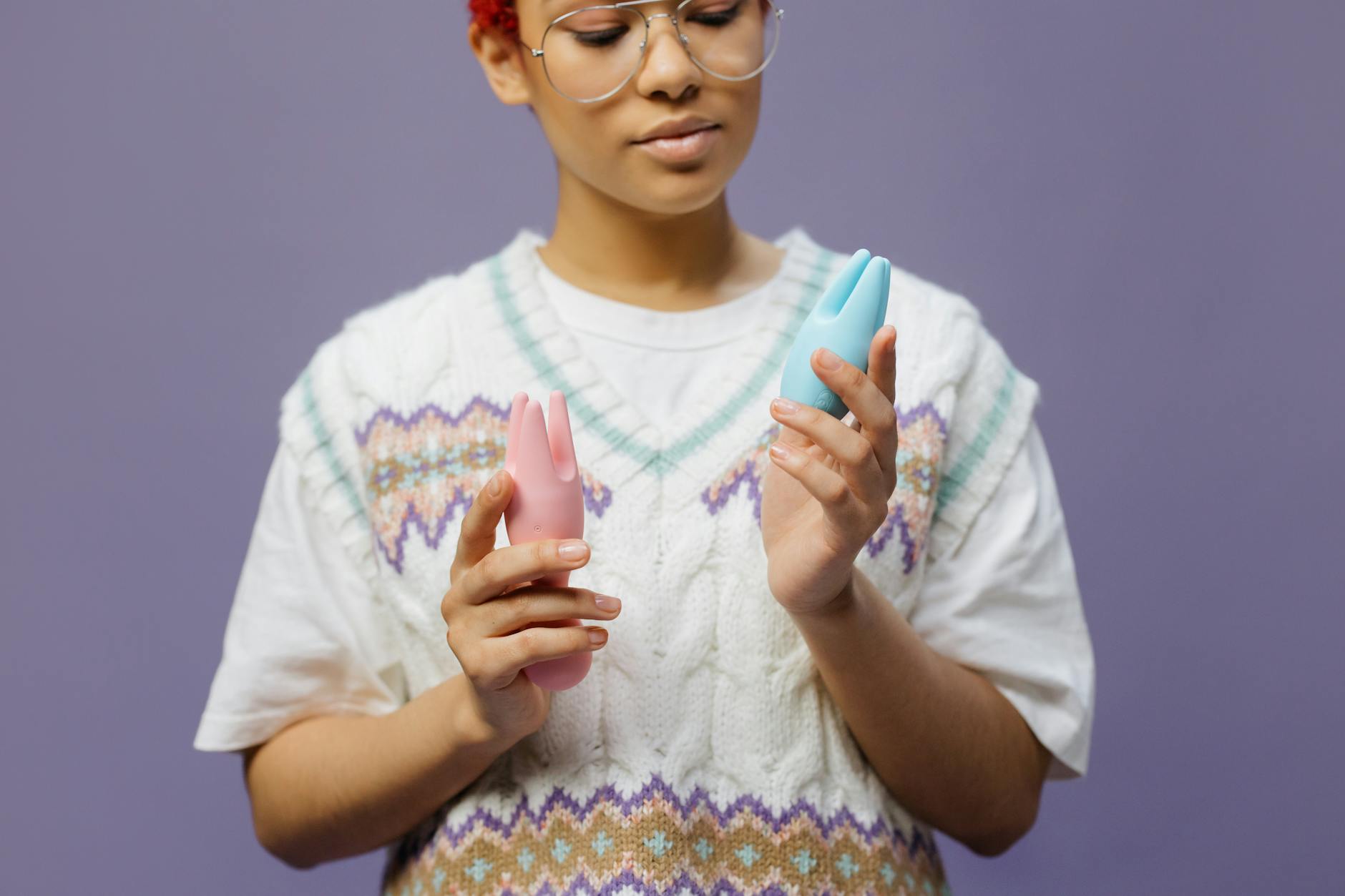
Let's talk about what highly sensitive actually means
Your clitoris has roughly 8,000 nerve endings packed into a space the size of a pea. If you're someone with a highly sensitive clitoris, those nerves are firing on what feels like the lowest threshold. Direct stimulation, even gentle, can feel overwhelming, sharp, or too intense to enjoy.
Here's what I want you to know first: this is not a dysfunction. It's not something you need to "toughen up" about. Clitoral hypersensitivity is a real physiological variation, and it responds brilliantly to the right approach.
Most vibrators on the market are built for average sensitivity. They press directly against tissue and buzz at frequencies that work for a wide range of people. If you're highly sensitive, that direct contact can feel like static, pain, or a kind of numbing overload. You end up either white-knuckling through it or giving up entirely.
Why traditional vibrators don't work for sensitive tissue
A standard vibrator creates pleasure through oscillation. That means it's moving back and forth against the clitoris at speeds ranging from 3,000 to 10,000 vibrations per minute, depending on the toy. The more powerful the motor, the more intense the sensation.
For sensitive clitorises, this is usually too much, too soon, and too direct. The nerve endings get overstimulated before arousal has a chance to build. What happens then is you feel pressure to push through discomfort, which creates tension in your pelvic floor, which makes everything worse.
That's the trap. And it's why lemon suction vibrators work so differently.
The physics of suction versus vibration
Instead of pressing and oscillating, a lemon vibrator uses gentle suction. Think of it like a light kiss that's constantly pulling, not pushing. The stimulation spreads across a wider surface area rather than concentrating all sensation into one point.
When you use a lemon clitoral vibrator designed with suction, here's what changes:
First, there's no direct friction. The toy creates a seal and then gently draws the clitoris upward into the opening, where nerve endings meet the sensation without harsh contact. Second, suction allows for a much wider range of intensity. You can start at settings that feel like a whisper and gradually build without jumping from nothing to overwhelming.
Third, suction distributes sensation. Instead of a single buzzing point, you feel stimulation across the entire clitoral structure, including the internal parts that extend deeper into your body. This is why many people with sensitive clitorises find suction toys revelatory. The sensation is richer and less sharp.
How to introduce suction if you've never tried it
If you're used to vibrators and you're trying a lemon suction toy for the first time, the adjustment takes maybe two or three sessions. Here's the approach I recommend.
Start fully clothed or with the toy over your underwear. Just hold it against your vulva without turning it on. Get used to the shape, the weight, the idea of it. Many people with sensitive clitorises benefit from a buffer layer at first. It sounds odd, but cotton between your skin and the toy can soften the initial sensation enough to let arousal build.
Once you're comfortable with that, turn the toy on at the lowest setting. Most lemon vibrators have 5 to 10 intensity levels. Start at level 1 or 2, not because you're fragile, but because you're gathering data. You want to know how your body responds when there's time and space between stimulus and sensation.
Keep it there for 2 to 3 minutes. Don't expect pleasure yet. You're teaching your nervous system that suction is safe, that it's not going to ambush you. After a few sessions of this, your body will start to recognize the sensation and arousal will begin to build more naturally.
The technique that changes everything for sensitive clitorises
Once you've acclimated to the sensation, here's where technique becomes essential. Rather than keeping the toy in one place, try a gentle rocking motion. Move it slightly side to side, or in small circles. This prevents the buildup of overstimulation because the pressure point is constantly shifting.
You can also use the intensity levels like a conversation with your body. Start at level 2, stay there for a minute or two, then move to level 3 only when you feel ready. The key is that you're in control of the pace. You're not waiting for your body to catch up to the toy. The toy is following your arousal.
Most importantly: use plenty of lubrication. Water-based lube is your friend, especially with suction toys. It creates a better seal and makes the sensation feel smoother rather than grabby. Reapply every few minutes, or more often if you need it. Dryness is what makes suction uncomfortable. Hydration is what makes it sing.
When sensitivity is actually pain or numbness
There's a distinction I need to make here. Clitoral hypersensitivity (everything feels too intense) is different from pain during stimulation, and both are different from numbness where nothing registers at all.
If you're experiencing sharp pain or burning, stop immediately and see a gynecologist. That can signal vulvodynia, nerve damage, or skin irritation that needs professional attention. A lemon vibrator won't fix that. You need evaluation first.
If you're numb, meaning sensation is muted or absent no matter what you try, that's a separate puzzle. Numbness can come from medications, hormonal changes, desensitization from numbing lube, or pelvic floor tension. In that case, I'd suggest exploring our guide on how to use a lemon vibrator when clitoral sensation feels numb for more specific strategies.
But if you're sensitive (everything feels too much), a lemon vibrator with intentional technique is often the answer.
The emotional piece that matters as much as the physical
Here's something I see often in my practice. People with sensitive clitorises have often internalized the idea that their body is difficult or broken. They've been told to push through, to use numbing cream, to have a partner "go easy," as if ease is a lack of effort rather than an actual adjustment.
That messaging sits in your nervous system. When you approach a lemon suction toy, you might be bracing for pain or overstimulation because that's what you've learned to expect. That tension absolutely affects pleasure.
So before you pick up a toy, remind yourself: sensitivity is information, not a problem. Your clitoris is telling you that it responds best to a certain type of stimulation. You're not accommodating a weakness. You're honoring what actually works for your body.
Take your time. There's no performance standard here. Your pleasure is the only metric that matters.
Pairing sensation with what else feels good
Sensitivity doesn't exist in isolation. It's part of how your entire body responds to touch, temperature, texture, and emotional connection. If you're using a lemon vibrator, you can deepen the experience by paying attention to what else supports your arousal.
Some people find that lower light, specific music, or a particular room temperature makes a difference. Others notice that they're more responsive when they've had time to breathe, to settle, to feel safe. If you're with a partner, their presence matters. Are they nearby? Touching you elsewhere? Engaged and present, or checking their phone?
Sensitivity often correlates with what therapists call "context dependence." Your nervous system is more attuned to the full environment, not just the toy. That's not a limitation. It's richness. You get to design the whole experience, not just the mechanical part.
What to expect as you build your practice
Most people report that after two to three weeks of regular use, their threshold shifts slightly. Not because they're becoming desensitized (that's a myth), but because their nervous system has learned that suction stimulation is safe. Arousal builds faster, pleasure deepens, and the sensation feels less startling.
You might also notice that you develop a preference for certain intensity levels depending on where you are in your cycle, your stress level, or your relationship dynamics. That's normal. Your sensitivity isn't static. It moves with you.
If you find that even a lemon vibrator feels too intense at every level, there are still options. Some people benefit from using it over clothing, or through a thin barrier. Others find that pairing it with a partner's touch or emotional presence changes everything. And some discover that they prefer manual stimulation with a partner, or self-touch with no toy at all, and that's valid too.
The goal isn't to use a vibrator. The goal is to find what actually brings you pleasure.
FAQ: Common questions about sensitivity and lemon vibrators
Why does clitoral stimulation feel numb or painful if my clitoris is sensitive?
Sensitivity and numbness can coexist. You might be hypersensitive to some types of stimulation (like direct vibration) while feeling numb to others (like light touch). Suction often bridges that gap because it's gentler than vibration and creates broader sensation. If pain is present, that requires medical evaluation first.
Can I use a lemon vibrator if I have vulvodynia or chronic vulvar pain?
Vulvodynia requires specialized approach. I'd recommend reading our guide on using a lemon vibrator when you have vulvodynia or chronic pain before trying any toy. Some pain conditions improve with gentle suction, others need different strategies entirely.
How long does it take to adjust to suction if I've only used vibrators before?
Most people adjust within two to four sessions. You're essentially retraining your nervous system to recognize a new type of sensation as safe. The key is starting at the lowest intensity and giving yourself permission to go slow. There's no rush.
Does being highly sensitive mean I can't have intense orgasms?
Absolutely not. Sensitivity and intensity are unrelated. You can have a highly sensitive clitoris and powerful, deep orgasms. Sensitivity just means you need the right entry point. Once arousal builds, release can be incredible.
Can I use regular lube with a lemon clitoral vibrator?
Water-based lube works best with suction toys because it maintains the seal better than silicone-based lube. If you're sensitive to most lubes, look for hypoallergenic, fragrance-free options. Some people with sensitivity do better with natural options like coconut oil, though that can degrade silicone toys over time.
What if my partner wants to help, but stimulation from them feels overwhelming?
This is worth a separate conversation. Sometimes external stimulation is genuinely too much, and sometimes it's about timing, communication, or technique. You might explore our post on how to use a lemon vibrator when you're disconnected from your body if the issue is about reconnecting to sensation with support.
The bottom line: Your sensitivity is your superpower
I've worked with thousands of people navigating their relationship with pleasure, and I've noticed something consistent. The people with highly sensitive clitorises, once they find the right tools and techniques, often report the richest, most nuanced pleasure. They're attuned to subtlety. They notice everything. That's not a curse.
A lemon vibrator honors that attunement. It says: your body isn't too much. Your clitoris isn't broken. You just need a different approach. And that approach exists.
If you're ready to explore what works for your body, start with what we've laid out here. Give yourself grace through the adjustment period. And know that pleasure that's built on honoring your actual sensitivity, not fighting it, is pleasure that lasts.
Have questions about your body or your pleasure? We're here. Reach out at /contact anytime.